- Basis Points
- Posts
- Evidentia’s Jo Cornwell: How to pick winning funds (and avoid blow-ups)
Evidentia’s Jo Cornwell: How to pick winning funds (and avoid blow-ups)
Watch, read or listen to the latest episode of Basis Points for 22 years of manager research experience distilled in 25 minutes.

Equity Mates
April 15, 2026

This week: Jo CornwellIf you've ever wondered how the pros really pick fund managers, today's episode is for you. This week, we’re joined by Jo Cornwell, the Head of Manager Research at $34.5 billion managed account provider Evidentia Group. Plus, we discuss the red flags advisers should look out for when backing funds. |  |
Evidentia’s Jo Cornwell: How to pick winning funds (and avoid blow-ups)
Picking a world-class fund manager sounds relatively simple. All you have to do is find a strategy with a great track record, right? Unfortunately, as we’ve seen even locally in Australia, even world-class managers can blow themselves up.
Jo Cornwell has spent 22 years on both sides of the institutional and wealth management divide. From Mercer to Aware Super, where she oversaw roughly $70 billion in assets, to her current role as Head of Manager Research at Evidentia Group. She has sat through more fund manager pitches than she cares to count, and her verdict on what actually separates the best from the rest might surprise you.
It's not track record, although that is important. And it’s definitely not a glossy presentation. It's culture.
Cornwell's research framework has found that team culture is a predictor of decision-making quality and, subsequently, long-term investment performance. While admittedly, this call is subjective, it’s one she's found to be remarkably consistent over time. The firms that do outperform, she argues, are the ones that have thought deeply about how their teams work together, not just what they invest in.
It’s probably not surprising then that the biggest red flag she has identified after 22 years of analysing fund managers is poor alignment. Where she's seen managers lose key people or their footing in the market, a poorly structured alignment model has typically been the culprit. She also believes that a solid business structure and a diverse client base are equally important.
On markets, Cornwell is measured, noting the Evidentia team is “keeping calm and carrying on”. In a world where equities look stretched almost everywhere, she's spending time researching the listed infrastructure world, which she sees as well-placed in an inflationary environment and a beneficiary of data centre buildout. Meanwhile, she flags global small caps as one of the few remaining pockets of value right now, but admits the team is spending time debating the benefits and risks of emerging markets exposure in portfolios.
She's also candid about the mistakes she sees advisers make repeatedly. This includes chasing recent outperformance, expecting it to continue indefinitely, and bailing on good managers at exactly the wrong moment in their cycle.
If anyone has ever backed a manager and regretted it, this episode is for you. Jo is transparent and forthcoming with her advice on analysing managers, eloquently distilling 22 years of research experience in just 25 minutes.

5 key lessons from Evidentia’s Jo Cornwell
1. The glossy pitch deck means nothing
Jo and her team barely look at fund manager presentations. Instead, they dig into how managers learn from mistakes, where they're finding new edges, and whether intellectual curiosity is baked into how they operate as a business. While a great track record is obviously table stakes, continuous innovation is what sets the good apart from the great.
2. Alignment is the red flag hiding in plain sight
Nearly every manager blow-up Jo has seen over 22 years can be traced back to a broken alignment structure. If the people running the money aren't meaningfully tied to the outcomes they're producing, or they no longer need their fund to succeed (i.e. money no longer matters to them), the whole thing starts to unravel. This is the main red flag advisers overlook.
3. Don't pull the plug too early on underperformance
Every manager has an alpha cycle. Jo's approach is to stay the course through underperformance if the thesis is still intact - meaning, the strategy, the people, and the process. With that in mind, the exit trigger isn't a bad quarter but a structural change within the firm.
4. Surprisingly, culture is a strong performance indicator
Jo's framework formally assesses team culture as a predictor of strong decision-making and ultimately, good investment outcomes. She argues the firms that consistently outperform in Australia tend to have thought deeply about how they work together, not just what they invest in. Good culture fosters good decisions. Surprisingly, almost nobody actually measures it.
5. The quiet opportunity: global small caps and listed infrastructure
In an increasingly volatile market, Jo sees two pockets of opportunity worthy of investors’ attention. She argues that listed infrastructure is a beneficiary of the inflationary environment (and it also has a growing data centre tailwind). Another interesting asset class is global small caps, which are currently undervalued compared to their large and mega-cap counterparts.

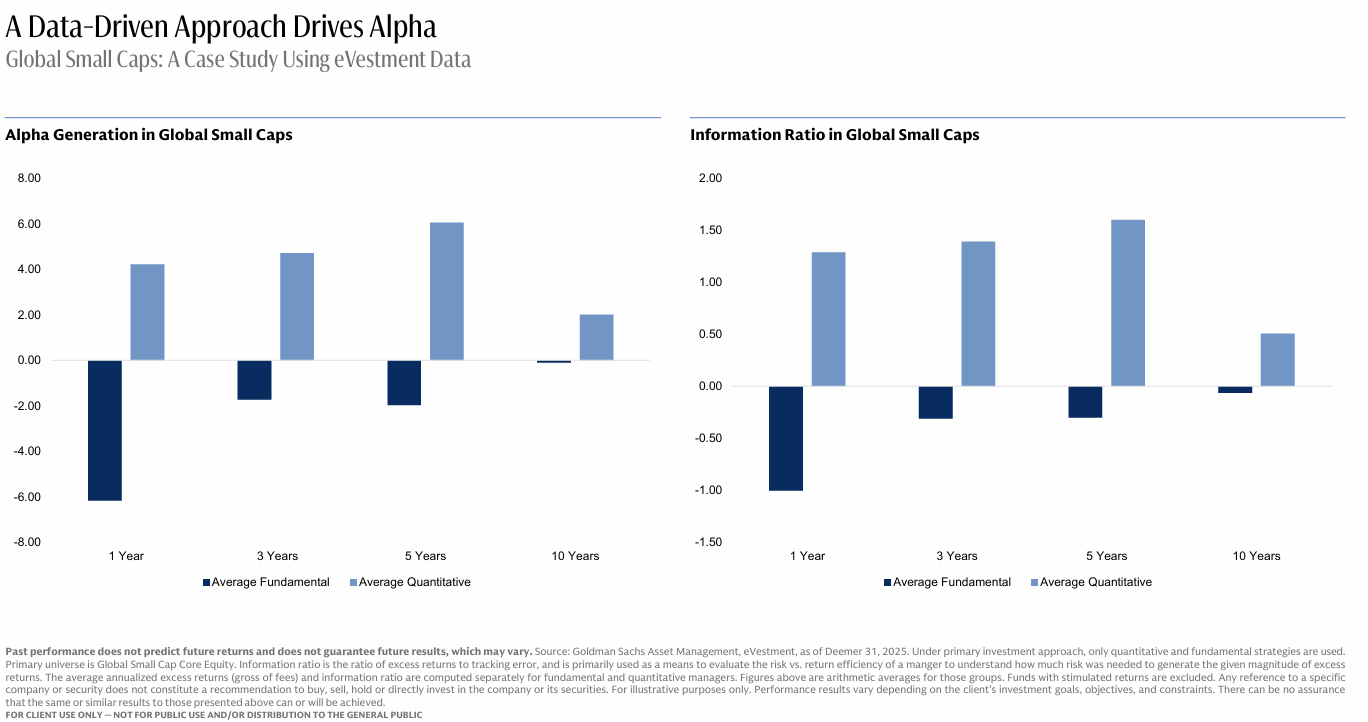
Jo has provided a chart from eVestment as our “chart of the week”, which demonstrates the benefits of systematic strategies over fundamental funds in global small caps over both the short and long term.
“The breadth of the market in global small caps can be very well suited to a systematic or quantitative style of investing,” she says.
“Over a number of different time periods, the alpha that systematic managers have delivered is actually greater than that delivered by fundamental managers. So, it’s making us really recognise the role that systematic investment management can play in a sub-asset class like global small caps.”

In case you missed it, last week we were joined by Shaw & Partners’ Candice Bourke. We discuss how she rapidly built a $600 million advice business in less than a decade. Plus, she also dives into the strategies she is employing to attract the next generation of clients.