- Basis Points
- Posts
- How this adviser built a $600m business in less than a decade
How this adviser built a $600m business in less than a decade
Plus, learn how our guest is tackling the intergenerational transfer, building client trust, and navigating market volatility.

Equity Mates
April 08, 2026

This week: Candice Bourke$3.5-$5 trillion is set to change hands in Australia by 2034. So, how can advisers secure this next generation of clients? This week, we’re joined by Candice Bourke from Shaw & Partners to answer that very question, as well as learn how she rapidly built a $600 million advice business. |  |

How this adviser built a $600m business in less than a decade
Eight years ago, Candice Bourke teamed up with her business partner Felicity Thomas, starting with a handful of retail clients on their books. They grew their client base like any other adviser would - events, networking, and face-to-face prospecting. Soon, happy clients started to do the heavy lifting, while the launch of their own podcast started to build familiarity and trust at scale.
Today, they manage $600 million across more than 140 holistic-advice-based clients.
Their podcast, Talk Money to Me, has become a genuine client acquisition channel. New clients regularly reveal that they feel they already know Candice and Felicity, having listened to the podcast on their daily commute. At the same time, Candice and Felicity have continued to establish themselves as thought leaders in the media, which has also helped grow their brand and trust with clients.
Not one to rest on her laurels, Candice is thinking seriously about where the next decade of growth will come from. With $3.5-$5 trillion set to change hands in Australia by 2034, and 65% of that wealth expected to flow to women, Candice believes she’s in the box seat. 50% of her client base is already female, and she’s focused on multi-generational family meetings, bringing teenage daughters into conversations early, and supporting women navigating divorce or inheritance to help secure the next generation of clients.
On markets, Candice is measured but honest: she sees more volatility ahead and is incrementally raising cash in her clients' portfolios. But her bigger message to advisers is this: market volatility is not the time to go quiet. Those who pick up the phone and communicate with clients when screens are red are the ones who will distinguish themselves from the pack.

5 key lessons from Shaw & Partners’ Candice Bourke
1. Focus on a multi-channel approach to scale your business
Candice and Felicity built a solid client base early on by focusing on active prospecting, establishing a media presence and launching a podcast. Now, referrals naturally flow from all three. The engine behind this growth is both building credibility at scale through content and a focus on client satisfaction, where happy clients who feel genuinely empowered become the business's marketers themselves.
2. Content and media presence are powerful (and underutilised) tools
Candice and Felicity’s podcast, Talk Money to Me, has become a meaningful lead-generation channel. New clients regularly divulge that they feel they "know" Candice and Felicity from listening to the podcast. In a profession where trust is everything, this familiarity dramatically lowers the barriers to engagement. Advisers who are not creating content are leaving what could be a significant competitive advantage on the table.
3. The $3.5–5 trillion intergenerational wealth transfer is the defining opportunity of the decade, and women are at its centre
65% of Australia's upcoming wealth transfer is expected to flow to women, yet roughly a third of women still don't feel empowered to meet their retirement goals. Candice's approach - running multi-generational "board-style" family meetings, bringing in family members as young as 15, and supporting women through divorce and succession - positions her business squarely in the path of this structural shift. Advisers who don't actively develop strategies for female clients risk being bypassed entirely.
4. AI is a productivity tool, not a relationship replacement
Candice uses AI daily for everything from tidying meeting notes to drafting client communications and broadening investment research beyond media narratives. But she is adamant that AI cannot replicate the emotional intelligence required to read a client's body language, understand their true risk tolerance, or hold their hand through a difficult life event. The winning formula is AI for efficiency, humans for empathy.
5. In volatile markets, proactive communication and a disciplined framework are what separate good advisers from great ones
With markets in correction territory, Candice uses a "traffic light" framework - where she assesses growth (PMI, CPI data), financial conditions (credit spreads, bond yields), and valuations - to guide measured, non-reactive positioning. Critically, she is picking up the phone and having difficult conversations with clients rather than going quiet. Her view: the best advisers can distinguish themselves during volatile markets.

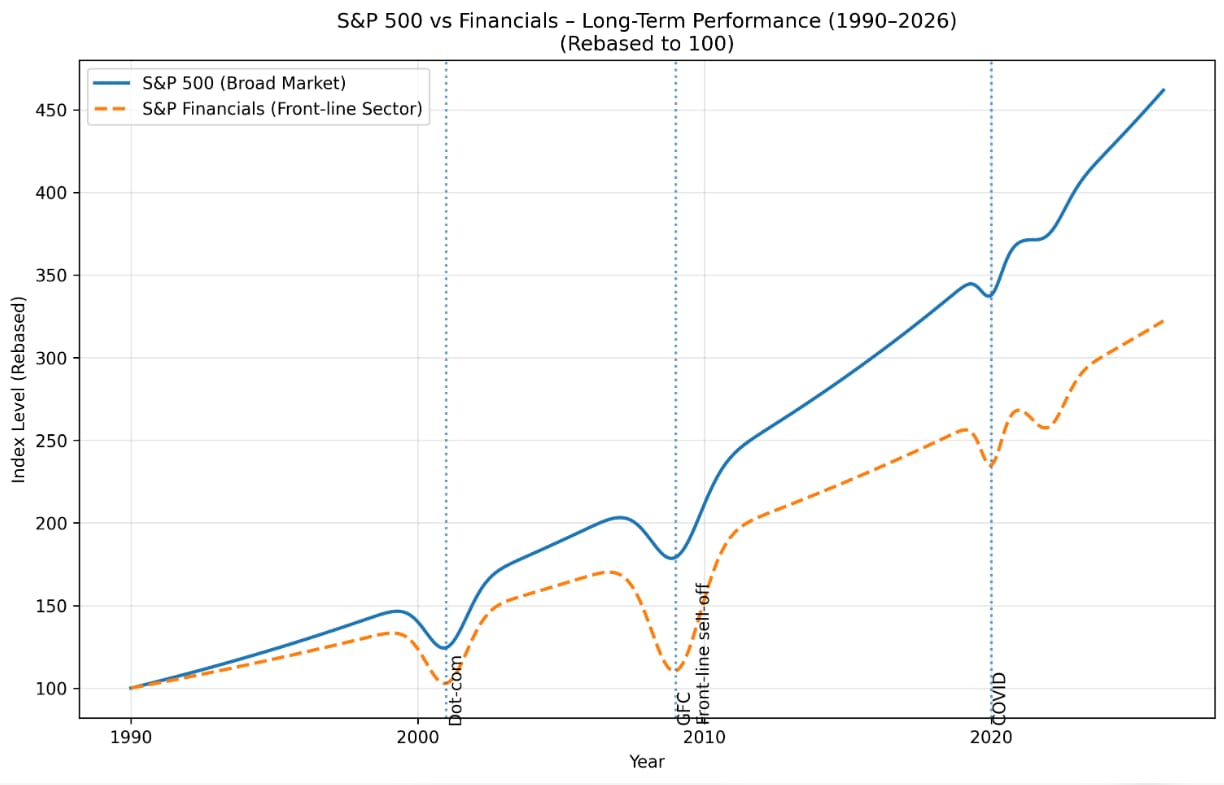
Financials are the frontline of the economy; they sell off first and fall harder in periods of stress.
Candice brought not one, but two charts for advisers and their clients this week. The first looks at the performance of US financials against the S&P 500.
“The banking sector is really the first line of defence in every economy,” she says, noting it touches everything from consumer spending, property, corporate lending, interest rates, M&A, and IPOs.
“What's interesting is that, year to date, the banking sector in the US has come off about 11%. So, that is in correction territory.”
Whether that’s just investors taking risk off the table after a solid 2025, Candice says the chart highlights that the financial sector will typically suffer the greatest shock in times of volatility.
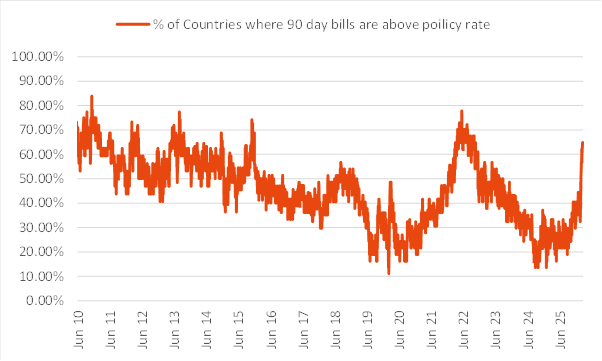
Current credit spreads indicate that financial conditions are becoming tighter.
The second chart demonstrates that financial conditions are getting tighter, with 10-year bond yields ticking closer to 5%.
“From that perspective, it's a mixed bag,” Candice said.
“I feel more confident investing when financial conditions are a bit looser because that flows into the banking sector, which then, as I said, touches all parts of the economy as well.”

In case you missed it, last week we were joined by Mary Manning, the CIO of the Albanese government’s $15 billion National Reconstruction Fund. We discussed the seven key sectors identified as “engines of growth” for the Australian economy over the next 20 years, as well as how advisers (and their clients) can get exposure.