- Basis Points
- Posts
- The woman deploying $15bn into Australia's future: Quantum computing, space & defence
The woman deploying $15bn into Australia's future: Quantum computing, space & defence
The National Reconstruction Fund's Mary Manning shares where advisers should be investing now.

Equity Mates
April 01, 2026

This week: Mary ManningThis week, we’re joined by the CIO of the Albanese government’s $15 billion National Reconstruction Fund. Manning discusses the seven key sectors identified as “engines of growth” for the Australian economy over the next 20 years, and how advisers (and their clients) can get exposure. |  |
The woman deploying $15bn into Australia's future: Quantum computing, space & defence
Mary Manning used to wake up in the middle of the night to check her Bloomberg terminal. Green or red? Night after night, that single question defined her. Working for Salomon Brothers, then George Soros, then Howard Marks at Oaktree, then Ashok Jacob at Ellerston - arguably some of the highest profile investors on the planet - her world was measured in real time, and every decision was benchmarked to every tick of the market.
Today, instead of answering to the world’s sharpest investors, she's now answering to every Australian taxpayer. She’s investing their money, in full public view, with parliament, the press and the market all watching. The Bloomberg terminal was one kind of pressure. This is something else entirely.
Manning is the inaugural Chief Investment Officer of the Albanese government's $15 billion National Reconstruction Fund. She’s shifted from focusing on daily market moves to honing in on investments that will reshape the Australian economy decades into the future.
So, where are our taxpayer dollars being invested?
As Manning explains, the NRF is focused on seven priority areas, including renewables, enabling capabilities (technology), defence, transport, resources, agriculture and medical science. Investments must also revitalise manufacturing in Australia, create jobs, improve the country’s national security, help the country decarbonise, and/or boost regional areas.
She's particularly fired up about a few areas most aren't watching, like quantum computing, where Australia is a genuine global centre of excellence. Space, where our geography gives us a launch advantage no other country can replicate. Defence, where the pipeline is the strongest it's ever been. And critical minerals, where listed market access is already available for investors today.
The question isn't whether you believe in Australia's economic transformation. The question is whether your clients can afford for you not to.
In this interview, Manning shares some of the public and private investments that she is truly excited about today, how advisers and their clients can get exposure, and what it’s really like dealing with the scrutiny that comes with investing taxpayer dollars.

5 key lessons from the NRF’s Mary Manning
1. Patient capital unlocks a different opportunity set
Manning's core message for advisers is that a slightly longer time horizon, even medium-term, not just long, opens up investment opportunities that are simply invisible to short-term thinkers. Clients with genuine five-to-ten-year horizons should be positioned accordingly, not managed to quarterly benchmarks.
2. Critical minerals and defence are structural thematics
These are sectors with structural, policy-backed tailwinds that Manning considers durable for the medium term. For advisers still treating them as speculative tilts, the NRF's conviction, backed by a government mandate and rigorous due diligence, is a reason to reconsider their weight in client portfolios.
3. Australia has genuine, hard-to-replicate competitive advantages in space and quantum
It may surprise some to learn that Australia's unique orbital launch geography and UNSW's globally leading quantum research represent structural advantages that are difficult for other nations to replicate. Advisers should be aware that early-stage exposure to these sectors is increasingly available through the VC ecosystem.
4. "More than money" is a client service model worth borrowing
The NRF doesn't just write cheques. It opens regulatory doors, provides communications support, and makes financial introductions. Advisers who think about what they offer beyond portfolio returns - like connections, referrals, and emotional steadiness in times of volatility - will build stickier, more defensible client relationships.
5. The listed market already offers access to the NRF's highest-conviction themes
Advisers (and their clients) don't need private market access to participate. Manning points explicitly to listed critical minerals and domestic defence stocks as the most accessible expressions of the NRF's priority sectors. If these themes are good enough for a $15 billion sovereign mandate, they deserve a serious look in client portfolios.

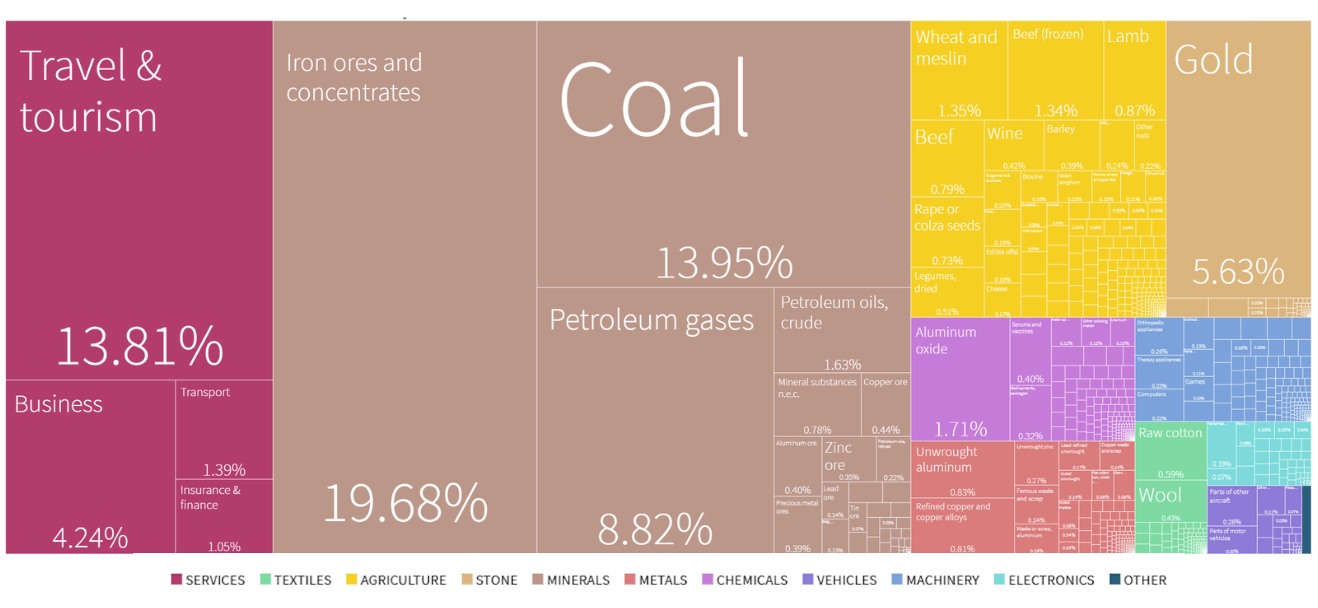
Manning brought the Harvard Economic Complexity Index as our “chart of the week” - bringing to life what the Australian economy truly looks like today. You’ll notice the usual suspects, like resources, commodities, agriculture, and financials.
Her ambition, and her mandate, is for that picture to look very different in 20 years.
“Australia’s economy will have been diversified and transformed. It will have supply chain resilience, we’ll make things in Australia, and we will have built new industries like quantum and space,” Manning said.
Whether she pulls it off is one of the most interesting questions in Australian finance right now. This episode is a great place to start forming a view.

In case you missed it, we were recently joined by Paul Burgon, the Managing Partner and CIO of Lipman Burgon & Partners, on the Basis Points podcast. Burgon, who ranked #4 in the 2025 Barron's Top Adviser List, argues the biggest concern facing clients is the “third-generation curse” - and he may just have the cure advisers are looking for.