- Basis Points
- Posts
- Why institutions are quietly buying Bitcoin
Why institutions are quietly buying Bitcoin
Global X ETF's Justin Lin breaks down the regulatory changes coming for the crypto market, revelations from 13F filings, and how advisers should allocate to the asset class.

Equity Mates
March 18, 2026


This week: Crypto Expert vs ScepticThis week, we were joined by Justin Lin, an investment strategist at Global X. While our host, Ally Selby, has long been a sceptic, somehow, Lin convinced her that cryptocurrencies should no longer be seen as the playground for scammers and fraudsters, but a regulated ecosystem with assets worthy of a place in strategic portfolios. Learn why in this episode. |  |
Why institutions are quietly buying Bitcoin
For years, cryptocurrencies had been cast aside as the speculative Wild West of the investment world. Its critics argued it was volatile, lacked regulation, and had no intrinsic value. Its association with crimes and fraudsters, like illegal marketplace Silk Road or the collapse of Sam Bankman-Fried’s FTX, didn’t help either.
But something has quietly shifted, at least in the last two years.
That’s according to Global X ETFs Investment Strategist Justin Lin, who argues that the asset class has moved away from its retail-driven origins to become an increasingly institutionalised asset class.
So, how did we get here?
The approval of spot Bitcoin ETFs in the US was the first real institutional catalyst, with US$12 billion flowing into these products in the first quarter of 2024 (after listing in January 2024). In its first year alone, BlackRock’s iShares Bitcoin Trust (IBIT), now the world’s largest and most-traded Bitcoin ETF, swelled into a US$53 billion behemoth.
Today, roughly US$110 billion is invested in crypto ETFs globally, while Bitcoin’s market capitalisation is around US$1.5 trillion. Perhaps most illuminating of all, 13F filings in IBIT remain elevated, despite falling prices in Q2 2025 (Bitcoin prices have fallen around 40% since peaking in October 2025), revealing that institutional investors have leaned in to Bitcoin’s recent price weakness (see below).
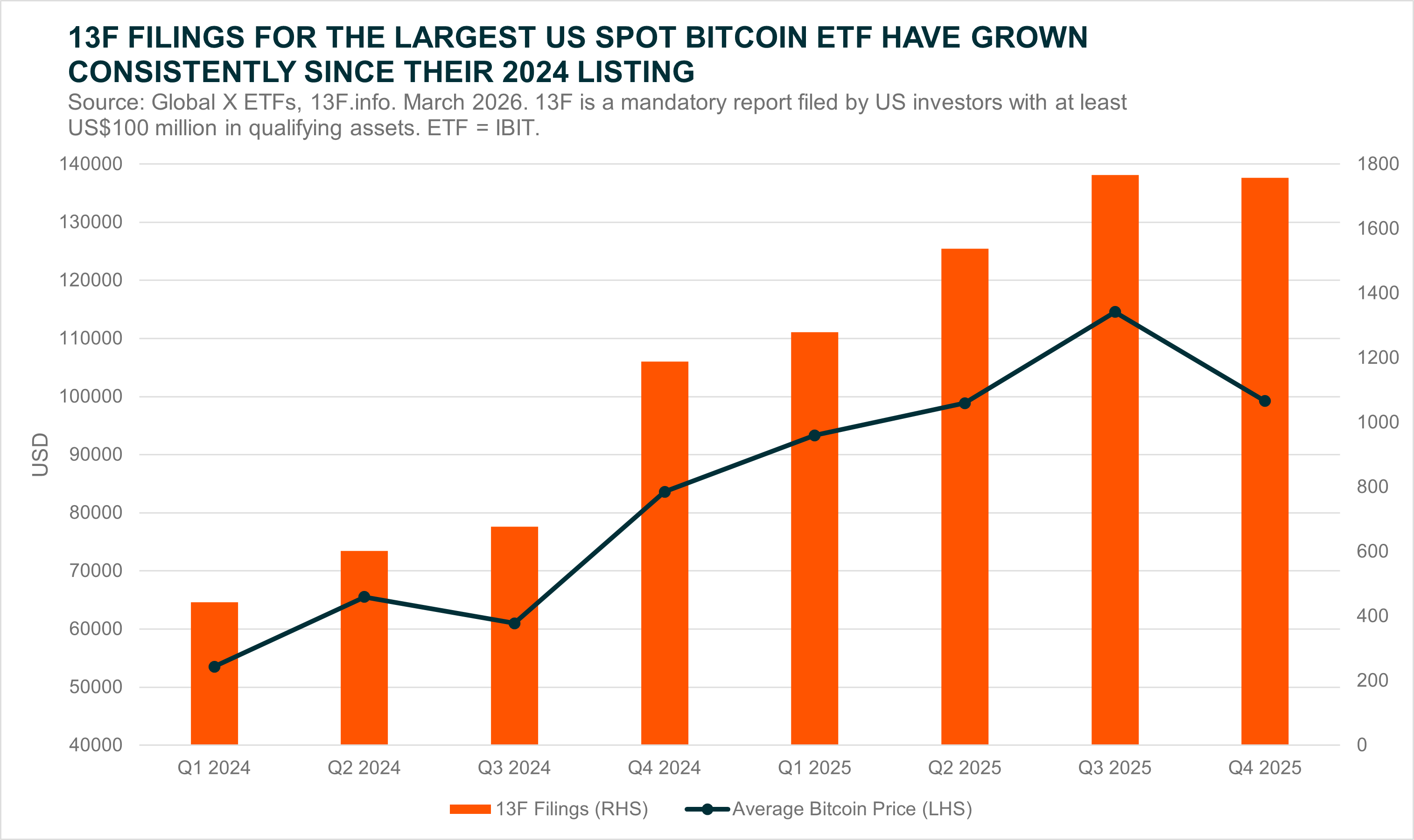
Despite falling prices in Q4 2025, 13F filings reveal institutional investors have continued to invest in Bitcoin, with 1,778 filings in the period for the world’s largest and most-traded spot Bitcoin ETF.
While Lin frames Bitcoin as a non-sovereign, apolitical asset with some characteristics that resemble gold, for advisers, the key question isn’t whether crypto will replace traditional assets, but whether it can actually improve clients’ portfolios.
He argues that Bitcoin has historically had low correlation to traditional asset classes (like equities and fixed income), and notes that even modest allocations would have improved risk-adjusted returns in portfolios over the last 15 years. That said, he suggests allocations of 1-2% as a starting point, or up to 5% for more aggressive portfolios.
In this episode, we also explore how Ethereum differs from Bitcoin, what upcoming regulation in Australia could mean for local institutional and adviser adoption, as well as the macro forces driving crypto prices.
If crypto has indeed moved from the fringe to an emerging institutional-backed asset class, advisers need to understand where it might fit - and where it doesn’t.

5 key cryptocurrency lessons from Global X’s Justin Lin
1. The US spot ETF approval was the real institutionalisation moment
Crypto ETFs existed in Australia and Europe before 2024, but adoption accelerated only after spot Bitcoin ETFs launched in the US. Once regulatory structures were approved, flows surged, and the asset class gained global legitimacy.
2. Bitcoin’s volatility is largely a function of its “youth”
Bitcoin has been heavily criticised for its volatility, but Lin argues that this reflects its relatively “youth” (17 years) compared to other asset classes, like gold (~6,000 years) or equities (~400 years). He argues that volatility tends to fall as market cap grows and ownership becomes more diversified.
3. Not all cryptocurrencies are created equal
Bitcoin and Ethereum are fundamentally different investments - with the former seen as a macro-driven asset or “digital gold”. Ethereum, on the other hand, is an open-source blockchain platform for running applications (like prediction markets).
4. Small allocations have historically improved portfolio diversification
Lin argues that Bitcoin has historically shown low correlation with traditional asset classes - around 0.2–0.4 versus equities and fixed income - explaining that even a small allocation of 1–2% could improve risk-adjusted returns.
5. Regulation could unlock the next phase of adoption
Perhaps counterintuitively, Lin argues that regulation, not decentralisation, could strengthen crypto markets. He notes that one of the biggest barriers to institutional investment has been unclear regulation. As it stands, Australia is strengthening its crypto regulation through the Corporations Amendment (Digital Assets Framework) Bill 2025, which requires platforms holding client assets to obtain an AFSL by 30 June 2026. Lin believes this clarity will bring peace of mind to advisers, institutions and super funds wanting to invest in the asset class.
Thanks to Cboe for sponsoring this email
Cboe’s Manager in Focus: Global X
Bitcoin’s latest pullback may feel dramatic, but current technical signals look strikingly similar to the 2022 cycle-end, suggesting we’re nearing a local bottom and potential value zone.
Ownership data supports that view, with strong support around prior cycle highs, clear accumulation throughout 2024, and steady ETF inflows. Long-term holders and major crypto backers are also buying aggressively, a pattern that has often preceded market recoveries.
Although Bitcoin remains more than 40% below its 2025 peak, its price action is still behaving broadly in line with previous four-year cycles. Importantly, unlike earlier downturns, this bear phase has unfolded without major systemic failures, reinforcing the view that the asset class is becoming more mature.
Dive into the world of cryptocurrency with Australia’s first-ever direct-exposure Bitcoin and Ethereum ETFs.

Don Gunawan leaves Lonsec
According to an anonymous source, Lonsec’s Don Gunawan is no longer with the research and ratings house. Don had worked with Lonsec since August 2024, having previously worked for Evergreen Consultants, Mirae, Allan Gray and Russell Investments, and was Lonsec’s contact for private wealth managers, independent asset consultants and institutional investors.
Ex-Wallaby backs new property fund with 7% management fees
Former Wallaby Tim Horan is a non-executive director of the SP Property Trust, Exceed Capital’s latest investment vehicle, promising 8% p.a cash returns paid monthly. It comes with eye-watering fees, though, with a 1.5% acquisition fee, 1% DD fee, 7% management fees, 6% project management fees, 0.5% asset disposal fees, and 20% performance fees over an IRR of 10% p.a.
If you have a tip, please let us know at the link below. All tips are anonymous.

In case you missed it, Kerr Neilson, the Co-Founder of Platinum Asset Management and a Hall of Fame investor, recently joined us to discuss why he believes markets are heading into a period of profound disruption, citing geopolitical fragmentation, war in the Middle East, and fragile global oil supply as long-term threats. Plus, he shares where he is finding contrarian opportunities in today’s volatile market.